Wednesday, January 25, 2012

tips on tips on Sleep No More

Last night I saw the theater performance dance piece Sleep No More, which was fantastic.  In brief, the audience is masked and wanders around 4 floors of an old hotel while actors act out Macbeth in dance and pantomime.  It's really cool.

Because it's so unusual, people who have seen it like to give advice to those who haven't.  My friends did, and you can find tons of SNM tips online.  Many tips are repeated over and over, forming a common wisdom, but some I feel were, for me, a little off the mark.  So I thought I'd offer my takes on some common tips.  This is based on a single viewing, and every person's experience varies, but this is what I thought.

But First: Tips on whether to search for tips

Because Sleep No More is so unusual you might be tempted to try and maximize what you get from the experience by gathering advice.  I did that, and it worked well for me, but my girlfriend says she thinks she would have preferred going with less knowledge and expectations.  I think the ideal way to approach Sleep No More would be to see it twice, once totally ignorant of what you are in store for, and a second time before which you could look up how to see all the most interesting things (you'd have to go several times to see everything of note).  Sadly, my budget does not allow for that.

Outside of a few basics, like knowing there are bathrooms on the fifth floor and that you need to wear comfortable clothes and shoes you can run in, you might consider whether you're the sort of person who would prefer to just explore without preconceptions, or the sort who really wants a very specific experience comprised of the "best" moments.  Act accordingly.

Tips on Common Wisdom Tips 

Read Macbeth, or at least a synopsis, before going: Everyone says to do this, but I don't know how useful it really is.  I've read and seen the play, and I read a synopsis before I went, and I still didn't know who most of the people were.  And even when I knew who people were, and what scene was being acted out, I didn't feel that knowledge added anything to the experience.  If you're trying to get to specific scenes it's useful to know who the characters are so you know who to follow, but that's about it.  Truthfully, I think an argument could be made for experiencing Sleep No More with no idea of what Macbeth is about.  Then you and your friends could all try and figure it out afterwards.

Look in every drawer, check every door: People say if you open all the drawers in all the bureaus and desks you can find neat stuff, and that if you open closed doors you'll find secret rooms.  But there is so much to look at and so many rooms to see that unless you've already gone a couple of times it's seems kind of silly to bother with.  I did not find any secret rooms; closed doors generally just lead to rooms I'd already gone into through an open door, and while it's cool that you can open a drawer and find faded baby pictures, the diaries and date planners and whatever I looked at never had anything interesting written in them.  Personally I would rather see the performances than search for tchotchkes.  Of course, if you want to find secret rooms, google around and I imagine you can find exactly where they are.

Wear contacts if you need glasses: Since you have to wear a mask the entire time, it makes sense to not wear glasses if you can avoid it, for the sake of comfort.  However, I feel people exaggerate the importance of this .  My number-one worry about seeing the play was the my glasses would be a big problem, and they really weren't; they were probably less of an issue than when I watch a 3D movie.  Of course, if you have those really big, square plastic frames it might be more of an issue, but for me it was really fine. So wear contacts if you can, but don't fret if that's not an option.

Go it alone: People generally say that if you're going with friends, don't try and stay together.  Split up and follow who you like.  This is reasonable advice; since you can't talk you can neither coordinate actions well nor share thoughts on the performance, but it's also fun with a partner.  If you want to go as a pair, my advice is, decide on one person to be in charge.  You have to respond quickly sometimes, and since you can't say things like "I hear a sound over there, let's check it out," or, "this is kind of boring, do you want to look around?" it's easier if you just have one person lead the other.  You could of course switch leadership roles at some point if you like, just make all decisions ahead of time. I saw half the play by myself then teamed up with my girlfriend for the second half, and I think that's the best of both worlds.

A Couple of  Tips of My Own

Finding events: At times you will find yourself wandering around aimlessly with no idea where any of the actors are.  In this case, I found it is usually helpful to move towards the music that is pumped through various speakers.  While some areas simply always have loud portentous music, hearing an old song or a sudden rise or change in the music somewhere is more often than not a sign that something is happening there.  My girlfriend suggested that these are musical cues to help the actors know where they should be, which seems likely, as they all need to be tightly coordinated with each other to make this work.  The other thing to do is look for people moving purposefully.  Often they are either the actors or people following the actors or people who have seen the play before and know where something is about to happen.

Don't worry about missing stuff: There's a lot of stuff to see, and if you get a lot of advice and schedule things just right you could tailor-make a tour of great moments the way people with a week in Europe tour all the famous places.  But that's not really how SNM is set up.  It's an experience; take what comes, explore, and don't get hung up on every little thing (although it can be worthwhile to know of a couple of the coolest scenes and how to find them).

Come early regardless of start time:  We had a start time ticket of 8 (note: if you want maximum exploration time, get the earliest possible ticket, as regardless of when you enter you can stay until 10), but we were let in something like 20 minutes before that.  

Hang out a while after:  There's a nice little nightclub where you wait before the play and return to at the end.  You can see very good live music there, so hang out.  They also have drinks, and while I don't really drink, I had a sip of the absinthe drink my girlfriend ordered and it was very tasty.

Comments on my personal experience

These are just a few thoughts based on what I saw.  These are very specific, so if you want to go without knowing specifics, don't read this.

Who to follow: I followed Macbeth for a good while, and he has a lot of cool scenes.  I also followed one of the witches for a while, which was worthwhile, although a scene where she moves the forest goes on a little too long.  Macbeth or any of the witches can be followed to lead you to the cool strobe-light orgy scene.  I didn't follow the pregnant woman, but I came across her in a couple of good scenes so she's probably a good one to follow.  My girlfriend followed Lady Macbeth for a while and said she was very entertaining.

Lady with a suitcase: At one point I saw some meeting between a man and a woman, and then the woman went into a room, sat at a table, unlocked and went into another room, got a suitcase, and wandered around some more.  I followed her far longer than I should have, as she's really boring in that part.  So if you see her my advice is go elsewhere.  I hope she gets to do something interesting at some point.

Card game: If you're in the pool room and people are playing cards, it will go on for a while but then there will be a very entertaining scene.  You'll know it's coming when you hear music cues and a scuffle outside (I considered running out to see what was going on, but by that time I was probably better off waiting where I was).


Lady Macbeth's bath: If you want to see Lady Macbeth naked you can (right after the banquet scene), but I didn't think it was a very interesting scene.  

Who's who: 

Macbeth is dressed in dark clothes and has blood on his face for a lot of the play, but other characters are harder to describe without just describing the actors, which is pointless since they're not always the same.  There's a scene in a banquet hall with people moving in slow motion that is useful to figure out who's who.  In that, Macbeth is all the way to the left, Lady Macbeth is all the way to the right, and I think the guy in the middle is the king.  Two of the witches, one male, one female, are on the right side of the table; If I remember correctly, Banquo's ghost sits between them.  The other witch is on the left side making out with two people at once.


Saturday, August 27, 2011

My Ever-Shifting Concepts of Proper Lindy Dance Form

So, you start taking swing dance lessons, and the teachers tell you to do things a certain way. Then you take more lessons, and a teacher tells you something that conflicts with what you thought you were supposed to do, and you realize you either misunderstood your first teacher or have encountered two teachers with different dance philosophies. You correct, change, reverse and revise, just trying to get it right. And while you can’t ever really get it right, because there is no right, you can, over the years, find what works best for you.

Until you learn something new that works better.

Over the years I have taken a great many dance classes. Most of these have been in Lindy Hop (a.k.a. swing, jitterbug, whatever.) I have spent a lot of time trying to understand and refine the basics, often misunderstanding what I was told at first, often being told different things by different teachers, and eventually coming to some sort of interim conclusion about what I should be doing. This conclusion is constantly revised; as I learn, I discover more misunderstandings, or learn new ways that, combined with old ways, make my dancing a little better.

I once asked a very good dancer, how does one resolve all this conflicting information, and she said you just find what works for you. That is hard to do, so I've decided to describe the history of the evolution of my basic Lindy stance and posture. The goal is not to tell anyone how to do anything (because what do I know?), but just to perhaps shed some light on the process of dealing with conflicting information, and to show how easily what one believes can get turned around, and that being open to the possibility that you have it wrong is essential to growth. A friend once told me that there is no truth, only the search for truth, and if someone says they've found the truth all they are saying is they've stopped the search. Some dancers think they've found the true way to dance, but the longer I've danced, the more I've understood how little I actually know, and how many ways there are to approach Lindy.

I'm going to mention specific teachers and what I understood of their lessons. I want to emphasize that this is my interpretation of what I think they told me. Nothing I say should be considered to be a completely accurate conveyance of any teacher's lessons. In some cases I may be completely misrepresenting them.

Feet
One of the first things I was told when I started taking lessons was that I should be on the balls of my feet. My interpretation of that was that my heels should be high in the air so all the weight was centered on my toes and the front of my foot. I found this very difficult. I used to try going up and down on my toes as an exercise, but when I danced I would still keep dropping onto my heels.

There were two teachers that made me re-examine the need to keep my heels up so high. One was a teacher named Yuval Hod, who yelled at his students to quit dancing on their toes. That was one of his pet peeves (he taught class in cowboy boots, and seemed to be able to dance just fine in them). The other was an Argentine Tango teacher who said weight should be on the balls of my feet, but heels should be on the ground. This is how I learned that this was more a matter of weight distribution than foot position. Having your weight forward does not mean you need to have your heels up. You may not even necessarily need all the weight off your heels; I've heard of one teacher who apparently likes the foot quite flat, but since this is second hand I can't explain exactly what he said he wanted.

Teachers seem to vary on how up on the balls of your feet they feel you should be. Currently I dance with my heels just off or lightly touching the ground with the weight on the balls of my feet. But I think less in terms of my feet now than in terms of where my weight is.

Posture and Stance
When I first took classes I wasn’t told much about how to stand. It wasn't until at least pre-intermediate that I was told I should stand as though I were playing tennis or basketball. Knees bent, waist bent, weight on the balls of my feet.

The problem with being told to stand like you're playing tennis is you'll only have good dance posture if you have good tennis posture, which I did not. It was like telling someone to jump like a rabbit when the only rabbit they'd ever seen was Bugs Bunny.

My early dance posture was terrible. I knew I was supposed to lean forward forward and keep my chest over my feet, but I did that by curving my spine. If a teacher told me to straighten my spine, I would be up too straight, even leaning back, because I didn't understand how I was supposed to be angled.

I was helped less by sports comparisons than by looking at the best dancers. Their backs were straight, their knees were bent, and their behinds jutted out. They looked as though they were lowering themselves onto a bar stool.

I think the best way to indicate the proper Lindy stance, and this is used by many teachers, is the jump method. You simply jump and land, knees bent, back straight. When you land, you will land on the balls of your feet and you will be bent forward (at the hips) because if you don’t bend forward you will fall down. So basically you bend at the hips, you bend at the knees, your ankles are bent enough to bring your knees over your toes (more-or-less) your back is straight and your arms are a bit out from your sides in a way that helps you keep your balance. It is a natural position, and natural is a good way to go when dancing.

A lot of teachers recommend a fairly low, athletic posture in which there is a lot of bend in the knees (although this belief is not universal). I aspire to keep my knees very bent and the rest of my body bent accordingly, but truthfully I'm pretty upright, simply because my knees are a little worse for wear. But I do find the lower I go the more I'm into the floor and the more control I feel over my movements.
Much in the way my knees are never as bent as I would like them to be, my back is never as straight as I would like. I've had bad posture all my life, so correcting it is a slow process. I've gotten a lot of advice on improving posture; the most useful was that I should straighten my back not by thrusting out my chest but rather by lifting my sternum. It is also useful to think of the crown of the head rising towards the sky. If I had the hundreds of dollars necessary to take private Alexander Technique lessons, which focus on improving posture, I would do that, but on my own I am improving, slowly. (One useful concept I read by an Alexander Technique teacher: “there is no waist.” What this means is that we do not have a bendable joint where our belt loops are, and if we try to bend there, we are just curving our spine. If we keep our spine straight, then to bend forward we bend at the hips.)

Update (8/14/2014): Recently I was helped in my posture by a teacher named Lainey Silver, who said I was much too straight, got me into the proper position and kept me there, bouncing from foot to foot, until I felt it. I worked with it for a while, at first trying to exaggerate the position (I used Michael Jagger as a template; at times his back is virtually horizontal). I realized that a lot of my problems with always reverting to a very upright position came from not pushing my ass back, I was simply bending at the waist. That didn't lock me in place; I was like a lawn chair with multiple back settings that was positioned in between two notches and would always slide back to the more upright notch.

When I pushed my ass back instead of just bending at the waist, I could feel my body lock into a new position, the weight shifting to the back below forcing me to lean forward to counterbalance with my chest.

Doing this made sense of something told me by Joe Palmer, that when you move back you lead with your ass and when you move forward you lead with your chest. I was so upright that I couldn't really feel what that meant, but with my ass really back and my chest really forward, I realized the chest and ass are like the bumpers of a car, which also leads with the front or the back bumper depending on direction.

Frame and Arms
Frame is a really tricky concept, and something that teachers approach in a variety of ways. Wikipedia describes it as the body shape maintained by dancers, particularly in the upper body, but what that means in practical terms can be elusive.

In writing this, I had to consider whether the arms should be discussed as part of frame or if frame and arms are actually separate concepts. When teacher Joe Palmer discussed frame, he said it exists in four places, the shoulders, the chest and the abdomen, and the relationship between these is frame. He didn't say anything about the arms when discussing frame. So perhaps frame is simply keeping your back straight and your shoulders in place. But rightly or wrongly I think of arms as part of the frame, so I'll discuss it that way.

The first bit of frame advice beginners are likely to hear is to keep their elbows always at least a little bent. Beginning swing dancers, holding hands as they travel away from one another, are likely to only stop traveling when both arms have been pulled straight and their shoulders have almost been pulled out of their sockets, which is a very bad thing. Keeping the arm bent prevents serious shoulder damage, because then you have a more controlled stop with the bent arm absorbing the shock.

The frame I learned at first can be created by imagining there is a table in front of you a bit below your belly button. Lay both hands flat on the table about shoulder width apart with your elbows by your sides and a little ahead of the front of your body. Now without moving the hands, raise the elbows. I've also heard this described as being like wrapping your arms around a tree trunk.

One of my early teachers, Laura Jeffers, had an exercise in which students would dance with their arms frozen in this position, like Barbie arms. In real dancing, you cannot keep your arms positioned like that, but it's helpful to understand how a lot of movement can be created by moving the body rather than the arms. Because that's a lot of what frame is about, leading through body movement with the arms simply used to convey what the body is doing.

Laura later pointed out to me that while I was keeping my elbows bent, I was letting my shoulders slide forward. Shoulders, I learned, needed to be kept in place. What makes this difficult is you also want your shoulders relaxed. I am still struggling with this. To feel where your shoulders should be, lift them up, roll them back then bring them down (the last stop sometimes colorfully described as putting your shoulder blades in your back pockets. I have been told that rather than tightening the shoulders, you should feel the connection through your lats (the muscles below/around the shoulder blades), although teacher Adam Lee said if you keep your chest up and out (what he described as a "proud chest") then that will keep your shoulders in place.

My concept of frame at this point was that it was very solid. My goal was to keep everything in place; if the follow moves away from me, I keep my arms taut, if she moves towards me, or if I'm doing a cross-handed Charleston, I do not let my elbows get pushed behind me. For me, this was frame, but I later found that there is more than one way of looking at the subject.

When I went to the school Hop, Swing and Jump the instructor, Yuval, had students keep their elbows virtually clamped to their sides. A friend describes it as a dinosaur style, because keeping them in that position makes them into little stubby Tyrannosaurus Rex arms. This really forces body leads; if you keep your elbows to your sides at all times, you have to lead by moving your entire body. (While Laura and her teaching partner Matt Bedel (the one dancing with Laura in my link to her above) were always telling me to keep my frame up - "engage your frame" - and Yuval was always telling me to keep my elbows in, when I watched Matt and Yuval dance socially they seemed to keep their arms in similar positions, neither against the body nor raised up much. So perhaps ultimately their differences were more in how they taught frame than in how they approached it.

Yuval had one exception to the elbows-at-your-side rule. When leading the follow in, Yuval told us to step back, leaving our hand in place, then pull ourselves forward, an action that would pull the girl forward (Yuval would not have used the word "pull," which is a word Lindy teachers disdain, but that was how I understood it conceptually). I tried to do this, but it was new and difficult to understand. I was told repeatedly my frame was too stiff, but I had trouble with concept of a more relaxed frame.

I didn't really understand what relaxing my frame meant until I took a workshop by Skye and Frida, who took relaxing frame to its extreme. After years of being told not to let my arm fully extend, S&F told us to do exactly that. They began by having us hold hands while standing near each other, our arms hanging loose. Then the leaders walked backwards, arms still long and loose, until there was enough tension to lead the follow to walk forward. Then we were supposed to dance this same way, letting our arms full extend when we were apart, letting them hang down when we were together. Everyone was having difficulty with this; the bent elbow was such an ingrained habit that almost no one in class was able to fully relax it.

It was perplexing to be told something different, but then, that's what happens when you start dealing with advanced concepts. It's best to tell beginners to keep their elbows bent so they don't hurt themselves and dance in a jerky way, but if you understand how resistance and tension should feel, then keeping your arm slack works just fine, and gives your dancing a more relaxed feel.

I began to think of frame not as a specific way of holding your arms and shoulders, but as a matter of control and consistency. It's not so much about having an exact position as it is about keeping the feel. I went from thinking of frame as very solid to rather fluid within certain parameters (i.e., your elbow can be fairly straight but it can't be hyper-extended, which is what beginners do, and you still shouldn't be letting your elbows go behind your back outside of a Texas Tommy).

As I worked on relaxing my frame, I found that some follows who I really liked dancing with began to feel too stiff, and some who had felt too loose were suddenly far more comfortable to dance with. Although dancers who strive to match what the lead gives them continued to feel good and simply mirrored my changes.

Right now my frame varies a bit. I strive for a relaxed Skye and Frida frame, which I got to after first revisiting Yuval's lead with S&F's concepts in mind (it is always good to find where different approaches meet). But often I dance in tight spaces where my main concern is making sure the girl doesn't crash into anyone, so often I keep my frame tight and in because there's not room for anything else (when I asked Skye about tight spaces, he says you can keep your elbow bent and still have a completely relaxed frame, but that it's much easier to teach a relaxed frame by letting the arm straighten. Adam Lee, who is also a strict no-bent-elbower, suggested having your body turned to the left a bit so even though your arm is fully extended, the follow is still pretty close to you).

And thus here I am, weight slightly shifted forward onto the balls of my feet, back straight, knees bent, arms sometimes relaxed, but totally ready to learn that all of this isn't quite right.

The process never ends.

(I'd like to explain how a lot of these concepts came together for me when I worked on my draw and rock step, but this is already way too long so I'll stop for now.)


Friday, July 08, 2011

Google+ = Facebook-

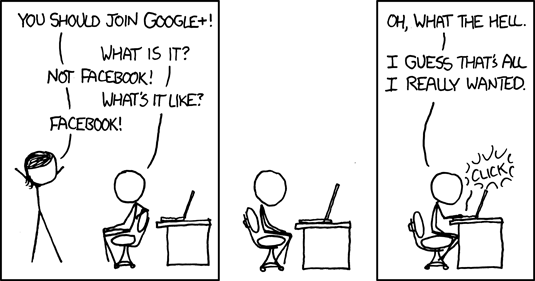
Everyone's beginning to join Google+ this week. Why? Well The brilliant xkcd summed it up well:


So I've been wandering over to G+ now and again to see who's showed up, and so far I am really, really underwhelmed.

The one notable thing about Google+ that I've seen is circles. Circles is a way of organizing your friends according to categories. You can categorize friends in FB, but it's a bit of a pain. G+ has a fairly simply system that seems to work well, at least when you've only got 10 friends. I have no idea how easy it is to manage once you have 100s.

Outside of circles, the main thing I've heard people like is chat. G+ really wants me to like chat too, as every time I went on the site it demanded that I click a button that said "enable chat." I clicked cancel each time, since I hate chat, but finally clicked enable without giving any circles chat permissions, in hopes that would stop the pop up. It didn't. I think I may have to create a circle with someone in it who would never chat with me, like Barack Obama, and try again.

People say G+ has a better chat than FB, that you can do audio chat and group chat and whatever, but I don't give a shit.

Outside of circles and chat, G+ is so far notable for how much less you can do on it than in FB. Take something simple like sending a message to a friend. In FB you go to a friend's profile page and click send a message and then you write your message and send it. But you can't do that in G+. You have to go to your homepage, write a message the way you write a status update in FB and then choose the person you want to send the message to.

Status updates are also a pain. You can't just click post. Instead you have to select what circles you want to share with. Every, single, time. You can't just create a default, you always have to choose. The first couple of times I couldn't even get my status update up because I didn't understand the three step process in which you write your message, choose your circles and then send. It's not difficult, really, it's just not intuitive.

Of course, it's nice to have a simple system in place that allows me to post specifically to certain circles. It's a good idea. It's just I generally don't post things to just certain groups, I just post things to everyone, and I'm content with that.

Photo sharing seems alright, if you don't mind the slideshow presentation people complained about when FB added it, but once again FB has a simpler way to do something; to make a photo your profile image in FB you can just select a photo, but in G+ you have to go to your profile, start editing it and then get the picture you want. Is this a choice, or just something they haven't fixed yet?

That last question is key, because I have no idea how much google is going to add to this. But right now you've got something far less useful, intuitive and user friendly than FB. Like most people, I would love to give FB the raspberry and move to something better, but at the moment, far from being better, G+ isn't even as good.

But then, to be fair, I didn't like FB when I came over from MySpace. Ultimately what's important is how people wind up using G+. I just don't see that there's anything you can do right now on G+ that you can't do on FB, making switching utterly pointless.

Wednesday, July 06, 2011

An Open Letter to a Number of Dancers I Know

Dear Dancer,

Something has been bothering me for a while, and I just feel I have to say something about it. I know this will be a tough thing to hear, but I feel that it's something that needs saying, and I hope you'll take it in the helpful spirit in which it is intended.

You are not as good a dancer as you think you are.

Look, I didn't want to say anything, but the way you keep criticizing other dancers is driving me nuts. You will complain, with deep, bitter vitriol, about how dancers who take classes above their level drag down a class, and yet, I have seen you in classes you clearly weren't ready for, being that person everyone is dreading in the rotation. I have heard you bitch about how snobby dancers are who won't dance with you because they don't think you're at their level, and I have seen you snootily turn down dancers who you thought weren't at your level, even though in some cases they were actually just as good as you. You complain constantly that dancers reject you because of your age or looks or ability to be part of a social scene and never consider the possibility that you're not as much fun to dance with as you think you are. You are like those people in Dear Abby who write "I'm attractive and have a terrific personality, but I can't get a date," without seeming to consider the possibility that they aren't the catch they think they are.

It is very difficult in dance to gauge one's level of dance competence. This is not chess, where you are unambiguously worse than the people who always beat you and unambiguously better than the people you always beat. Dance is a cooperative activity, so you cannot truly be ranked as an individual. Each dance is a little partnership, and when we dance with really good dancers it feels so good that we naturally take a certain amount of credit for the wonderfulness of that dance, even if in reality our partner is, in some cases, a brilliant dancer struggling mightily to get the best out of a bad situation.

So I completely understand why you would think you're a terrific dancer. And compared to some people, you are. You completely wow those who have just started dancing. They find it hard to imagine being able to do what you can do. So sure, be proud of your accomplishments. You've worked hard, and high self esteem is a terrific thing to have.

But don't be too proud, because you're not nearly as good as you think you are.

I know you would reply, "I don't claim I'm the best." That's true, you don't. But that just means you're not clinically delusional. You also don't claim you're Abraham Lincoln or Jesus. Not being completely crazy does not mean you aren't wildly unrealistic. You are less humble than some of the best dancers I know. Those dancers are always aware of how far they still have to go to be as good as you think you are right now.

I know as you read this you're thinking wow, I know people just like that. This open letter really describes that sort of person beautifully. So I just want to make it clear: I'm talking about you. Not other people, you. And I know now you're thinking, good, he's letting those other people in denial know that they're the problem. But no, I'm letting you know that you're the problem. You. I don't know how else to get this across. It's an open letter, so you might see one sentence that really doesn't apply to you, but over all, yes, this is about you. Seriously.

I'm not saying I'm a better dancer than you. I may believe I am, but I'm sure I'm not as good a dancer as I think I am either, so how can I judge? And I'm not saying you need to become a better dancer. Certainly improvement is always a good thing, and the better you dance, the more fun dancing becomes. But you don't fall down and you have the basic mechanics in place and really, that's enough to get by. We are all limited by our natural talents and the amount of money we have for lessons, and some of us reach a point at which we probably are about as good as we're going to get, and there is nothing wrong with being only the best you can be.

I'd just like you to drop some of the attitude. Quit whining so much, especially in areas where other people are whining about you. Please keep in mind that you don't know everything, and that "judge not lest ye be judged" is really good advice.

When you crash into someone on the dance floor, don't assume it's always their fault, or your partner's. When you don't pass an audition, don't assume it's because the judge has a grudge against you, or is jealous of you, or just gave all the spots to his or her friends. Don't tell your friends you would have got into that dance troop if you hadn't got a bad partner who made you look worse than you are. I'm not saying that's never the case, but it's certainly not always the case.

Like you, I have believed I knew more about dancing than I did. There is a point where we have climbed so far that we think we're near the top, failing to recognize that we're actually still really close to the bottom. Then we give bad advice to beginners and cling to bad habits with a certainty that we have reached a point where we know what we're doing. Once you reach this point, you need to get to that next place, where you understand how utterly clueless you still are.

So before you turn down that struggling beginner, or bitch about that professional dancer who didn't seem enthusiastic about dancing with you (is a chess master expected to enthusiastically play that bright 8 year old?), or act like the whole world just doesn't appreciate you the way they should, pause, take a breath, and say to yourself: "I am not as good a dancer as I think I am."

Friday, March 25, 2011

Midseason 2011 New TV Series Capsule Reviews

Once again, I am posting little reviews of TV shows, because why have opinions if you aren't going to blog them? I’ve seen all the new shows since January except Harry’s Law, which for some reason I have not seen but which my mom claims is pretty good, for whatever that’s worth. Here's what I think of the one's I have seen:

Fairly Legal

Premise: Cute legal negotiator negotiates cutely.

Review: Fairly Legal is a cute legal drama whose twist is that the lead is not a lawyer. Instead she’s a negotiator who tries to bring partners to an amicable settlement (a talent she also brings to virtually ever personal encounter). The show is very predictable, with a lead who works pretty much 24/7 to make every case turn out well and the sort of magic bullet wrap up of shows like The Good Wife in which the problem is solved because something is discovered or proven that makes it all black and white. This seems inappropriate for a show about negotiators, who by definition must have to come up regularly with rather messy solutions. But the lead is personable and attractive so what the hell.

Will I keep watching it? Yes, for now.

Mr. Sunshine

Premise: Curmudgeon manages arena.

Review: This is a formulaic but fairly amusing show staring Chandler from Friends as the manager of some sort of arena for sports and concerts and what not. It’s got a solid cast and is decently written, but probably would be a just-miss if not for Alison Janey’s very funny turn as the batshit crazy owner of the arena.

Will I keep watching it? Sure

Traffic Light

Premise: Friends chat on the phone while driving and lie to women.

Review: Traffic Light is a show I instantly disliked from the opening scene of some ex-hipster-looking asshole chatting on his car speaker phone with his buddies. There is something very distasteful about the show, which has this weird “battle of the sexes” vibe that feels like a throwback to comedies of the early 60s. It’s about three guy friends, one just moving in with his girlfriend, one who’s married, or in a long-term relationship or whatever, and one who goes from girl to girl. The first episode focuses on the married guy’s attempts to come up with a warning system for his car’s speaker phone for when his wife is in the car so he can keep his life secret from his wife, who is far smarter and nicer than any of the guys. That episode ended with this weird sappy speech at a funeral that came out of nowhere even though it gives the series it’s title.

The annoying thing is, it’s a pretty funny show, which has kept me watching it. Some of the battle of the sexes stuff is quite clever. The footloose fellow always cleans his apartment of all traces of women after they’ve stayed over out of fear they’ll move in lipstick by lipstick. When his current girl asks about the toothbrush she left that he threw out, he feigns ignorance. She keeps searching, and then suddenly says, “oh, here it is” and holds up a toothbrush, and of course he can’t say anything even though he knows she snuck it in. It’s really quite funny, even though the premise is unpalatable.

Will I keep watching it? Yes, until one episode isn’t funny and then forget it.

Perfect Couples

Premise: Three couples who are friends do couply and friendly stuff.

Review: Perfect Couples is Traffic Light’s opposite in terms of showing relationships. Here you have three couples, one tempestuous, one normal, middle-of-the-road type and one just odd couple in which the wife in one episode decides her husband needs a “man cave” where he can express his masculine side. This shows a more nuanced version of the battle-of-the-sexes concept, in which sometimes the guys might want to hide something, or get away with something, or in some way conspire with the other guys, but just as often work alongside their partners. It’s like real world politics in which alignments can shift depending on the objectives. Also, unlike Traffic Light, the characters are all very likeable and real. And it’s funnier than Traffic Light.

Will I keep watching it? Absolutely

Lights Out

Premise: Boxer loses career, joins a collection agency.

Review: It’s like most shows on the FX network, something that seems pretty intelligent and well done that I just can’t get into.

Will I keep watching it? No.

Mad Love

Premise: Couple falls in love at first sight and takes it from there.

Review: Mad Love is going to make me mention Traffic Light one more time, simply to say that it too is an opposite of that show, but in a different way. Because while Traffic Light is funny but unpleasant, Mad Love is likeable but not particularly funny. It follows a young couple falling in love assisted or opposed by their “wacky” friends. It is very formulaic, and kind of dull, but also kind of sweet. That makes me hope it succeeds even though I’ve stopped watching it.

Will I keep watching it? Naw.

Bob’s Burgers

Premise: Guy runs a burger place with his family.

Review: This show is somewhat reminiscent of Dr. Katz, with the same shaky animation and skewed, sardonic humor. It’s not as funny as Katz was, but it’s funnier the also-similar Home Movies.

Will I keep watching it? Sure, why not.

Episodes

Premise: Brilliant British sitcom is remade Hollywood style.

Review: I enjoy series like The Larry Sanders Show that mock Hollywood, and Episodes does it very well. The series revolves around a couple who created a successful, admired British sitcom and is lured to Hollywood where their vision is compromised at every turn and their lives fall apart. Funny and clever, with a biting wit and a lot of hostility towards Hollywood phonies, which according to this show means pretty much everyone.

Will I keep watching it? Absolutely.

The Cape

Premise: Some sort of superhero crap.

Review: I watched a little of this. Some guy has a cape that makes him a superhero or something. Aims for a gritty, tough thing, just achieves being dark and lifeless. Didn’t make it through the pilot. I really like superhero stories, but Hollywood’s attempts to recreate the success of Heroes have foundered horribly.

Will I keep watching it? No. I don’t even know if it’s still running.

Shameless

Premise: Drunk dad, precocious kids, something like that.

Review: Watched about half of the first episode. It seemed decent, but I just couldn’t get into it.

Will I keep watching it? Naw.

Off the Map

Premise: Gray’s Anatomy in the jungle.

Review: I didn’t see the premiere and only wound up watching this when I was looking for something to watch on my girlfriend’s free-tv-on-demand station. It’s something about doctor’s working in a little town in some foreign place. I’ve seen a couple of episodes, and you know, it’s kind of decent. Although since I haven’t watched the episodes sequentially, I’m not sure who anyone is or what’s going on.

Will I keep watching it? Maybe.

Being Human

Premise: Vampire, ghost and werewolf become roommates.

Review: I watched the first season of the British version of this series, which was quite good, even though I lost interesting in the second season. Much of what made the show good were the appealing leads, a conflicted vampire, nerdy, depressed werewolf and hot, charming ghost. Unfortunately, the cast in this one is markedly blander, with only the ghost offering any personality. I watched one episode and that was it.

Will I keep watching it? Nope.

The Chicago Code

Premise: Chief of police and friend cop battle corruption.

Review: This was decent, but after two episodes I felt like the show was already running out of steam. To be fair though, I don’t think I’ve stuck with a dramatic cop show for more than a few episodes for years.

Will I keep watching it? No.

Wednesday, January 12, 2011

left or right, there's no need to be an asshole

Someone who was clearly batshit insane shot a bunch of people in Arizona at a political event. Not the first time, not the last time. Some on the left are trying to blame Sarah Palin graphics and partisan bickering, but as David Brooks points out in the Times, that's nonsense. As my girlfriend and Jon Stewart have both said, it's just like people who blamed heavy metal music for violence and suicides. Tragedy should not be thought of as an opportunity to try to score cheap political points. Alas, it always will be.

Friday, December 31, 2010

Musings on Good Dancers, Bad Dancers, and the Surprisingly Subjective Nature of Deciding Which is Which (A Very Long Essay)

Good and bad, I define these terms
Quite clear, no doubt, somehow.
- Bob Dylan


It is a truism that the more one learns, the less one knows. When we know only a little about something, we have a shining certainty, but with knowledge comes perspective, which leads to the question: How sure can any of us really be about anything?

Lately I’ve been thinking a lot about “good” dancers. Swing dancers, specifically, since that’s what I spend most of my time doing.

For many years, I thought of good dancing in purely linear terms. I had the image of a ladder in which there were people above and below me. I think most people I know are similar, feeling sure about who the good and bad dancers are, who is great, who is terrible.

Dancers also generally have an opinion of where they are on the skill ladder. They are often wrong. Most commonly, dancers who have been doing it for a while assume they are better than they are. Many dancers complain vociferously about dancers deluded in this way, and most of those complaining are just as deluded. Much in the way that people think they have great singing voices until they record their voice, most dancers assume they are moving beautifully until they see themselves on video. (Some dancers, newer to the scene, will, refreshingly, think they’re worse than they are.)

The cold hard fact of social dancing is that when the dance is bad, it might not be your partner’s fault. It might be your fault. Or it might be something else entirely, and that something else is the point of this essay.

What is a Good Dancer?

So let’s begin by thinking about what good partner dancing is.

In the most subjective sense, a “good” dancer is someone you enjoy dancing with. But among people who have taken a lot of classes and learned a lot of technique, the term is often used to refer to people who have good technique; good dancers have good dance posture, good balance, good musicality, a good connection with their partner and a feel for the physics of the dance.

To some extent, that is all true.

But before we worry about technique, let’s think about what partner dancing is; dancing to music with a partner.

At its simplest, it is what is referred to by dancers, derisively, as “wedding dancing.” Wedding dancing is what people who don’t dance do at weddings when they try and recreate the vague notion in their head of partner dancing. They hold hands, they sway back and forth, they spin around. Wedding dancing is ugly to watch and it is terrible to dance with someone who thinks that is what dancing is. But is it inherently bad?

It depends. If they are having fun and they are dancing on the beat, well, it is a successful dance. If they are communicating through movement – that is, if the leader successfully gets the follow to turn the direction he wants her to – then it is even a successful partner dance.

It is, in fact, street dancing, and street dancing can be a very interesting thing.

On Street Dancing

I learned to dance in dance schools, and wasn’t aware of street dancing for many years. It came to my attention first when I went salsa dancing at a bar in the East Village. The dancers there, all Hispanic except for me and my friend - were clearly not people who had learned to dance in a school. While I had learned specific footwork and a lot of turns, these people were holding each other close, moving to the music, doing nothing elaborate but looking really sexy and cool. They seemed not like people who were taking dance classes but like people who had been dancing in salsa clubs for years, just making it up as they went along. (Years later I discovered blues dancing and realized that street salsa was much closer to blues dance than to school salsa.)

I once spoke to a guy who had grown up somewhere in Central America and had started dancing salsa as a teenager. He said salsa dancing was just dancing to salsa music. When I asked how he learned the basic step, he said, “there is no basic, you just dance to the music” as though I was a little slow.

Not all dances are street dances. Some are created and popularized by dancers, like the Foxtrot, which was presumably invented by Harry Fox and popularized by dance superstars Vernon and Irene Castle. But many start as street dances. Thus dances are created locally to popular music. I met an elderly woman who told me when she was young, swing dancing was different in each borough of New York, where she grew up; it was just kids who knew how to dance figuring out how to dance to new music and teaching other kids in the neighborhood what they were doing.

Some of those kids were in Harlem, and their version of swing dancing, Lindy Hop, is the one that caught on. It came out of older dances like the Charleston, and was popularized first by entertainers like Whitey’s Lindy Hoppers then was brought in somewhat altered form to Hollywood by Dean Collins and was altered for the masses by the Arthur Murray Studios in the form of East Coast Swing, a somewhat simplified variant that focused more on 6-count than 8-count steps to make it easier to learn for people familiar with Foxtrot. (At least this is what I have gleaned over the years.)

On Dance Schools

When a street dance becomes popular enough, dance schools start teaching it and it becomes codified. Much in the way that grammarians did not invent English but did decide on a set of rules so that people would speak it the same way, dance schools take the street dance and chop it up into clearly definable, teachable movements bite-sized bits so that anyone can learn it. This is not bad in itself – we can’t all pick up dance steps just by watching – but it does create a mindset in which there is a right way and a wrong way to dance, whereas in street dancing right or wrong is more a matter of, does it work, is it fun, does it look good, and did anyone die?

I learned Lindy Hop at the Sandra Cameron Dance Center, a dance school whose main claim to swing fame was that they employed Lindy legend Frankie Manning as a teacher. Sandra’s had practice sessions for their students twice a week, and for the first few years that is where I did most of my dancing. It was pretty clear who was a good dancer and who wasn’t, and I generally had a strong sense of where I was in the skill hierarchy.

Things changed when I started going out to swing dance events. People did not dance much like my fellow students at Sandra’s. Many dancers focused more on musicality and flair than on learned steps. It was both exciting and annoying, as many people focus on style before they really understand how to dance. But the experience changed my dancing for the better.

On Snooty Dancers

When you go out social dancing, some people will not dance with you. Most will, but there are a few people who stick to a small circle of acquaintances. These people are often thought of as being good dancers, partially because many of them look good when they dance, and partially because we always assume that people who think they’re too good for us actually are too good for us.

For a long time I thought the same, but had to reconsider after a dance teacher gave me his thoughts on those cliquish dancers. What he said, as best I can remember, was:

“They don’t dance with you because they think they’re better than you, but they’re not. Most of them don’t really follow. They have memorized leads to certain moves, and if they feel that lead, they do that move automatically, regardless of what you are trying to lead.”

Was this possible? Were the snootiest people on the swing scene nothing but back-leaders? Did they look good when they danced only because they were favoring their individual movements over the integrity of the connection? I began to think that perhaps looking good was simply a different skill from feeling good. If you have a dance background in jazz or ballet or modern you might be able to look great, because you know how to move, but you might feel awful, because you have terrible partnering skills.

Every once in a while one finds oneself in a club so empty that one of those follows who always says no surprises you and says yes. And dancing with those cliquish dancers seemed to prove that dance right. Because I found most of them terrible to dance with. They seemed confused by simple leads; things I could lead flawlessly with almost anyone left them standing there looking confused.

I began to think these dancers simply had a narrow competence. That when dancing with people they were familiar with, that they’d danced with hundreds of times, that they’d taken the same classes with, they could be amazing, but that they were rigidly incapable of dancing outside of their social circles.

But like every neat theory, there were holes in this one. For one thing, there were people I didn’t like dancing with who I knew were much better dancers than me. It can often be almost as hard to dance with extremely good dancers as it is to dance with extremely bad ones, because they have simply reached a point of subtlety in their movements that you aren’t competent to match. Yet, there were some amazing dancers I danced beautifully with, while other dancers who gave every indication of being just as good just annoyed me.

One of the big ah-ha moments in my search for answers came when the same dance teacher who had complained about cliquish dancers back-leading told me that one of my favorite people to dance with, who was also a teacher, didn’t know how to do a proper Lindy Circle. This was clearly nonsense. The problem, I suspected, was that these two had learned how to dance from Lindy teachers with radically different approaches to the dance.

While Lindy has been codified, the best dancers always play with the concepts they learn, trying to perfect and improve them, and then they teach other people. Thus, dance teaching evolves along separate tracks. They are all teaching Lindy Hop, they are all doing Texas Tommys and Swing Outs and Tuck Turns, but they have different approaches to compression, to stance, to counterbalancing. I can often tell what teachers someone has learned from by the way they dance, and I find I can sometimes improve my connection with a dancer by doing things in a way I learned from some specific teacher.

On Argentine Tango

Consider, for a moment, the Argentine Tango cross.

In Argentine Tango, the man can choose to step to his left so that he and the woman are walking on separate, parallel tracks. When this happens, the woman may take a step back and then slide her other foot back so that her ankles cross. How does this happen? It depends who you ask.

There are two basic approaches to the cross. One is that it is a lead move. You walk alongside the woman, and when you want her to cross, you give her a little push with your hand that forces her to cross.

The other approach is that the move is done by convention. If a man takes three steps in the outside track, she will cross on the third step. You do not, under any circumstances, lead this. It is simply a convention of the dance of long standing that every dancer should be familiar with.

I don’t know which of these is correct. Presumably I could go to Argentina and ask a 100 year-old dancer and he or she could say, this is the tradition, and I could say, that’s right then. Or someone could argue that the tradition is not important, that Tango is a living dance and that regardless of what was being done 80 years ago, this is the way to do it in the modern age.

I don’t really care which is right. I go with the cross by convention, because that’s how I learned it, but if I’d learned it the other way, I would do it the other way.

My point is, these two methods are both taught by a great number of teachers, and they are incompatible. If someone schooled in one method dances with someone schooled in the other method, there are going to be issues. She is not going to cross when he expects her to, and he’ll think, she doesn’t know how to dance. He’ll force her into a cross, and she’ll think, he doesn’t know how to dance.

In fact, they both know how to dance, they just don’t agree on the ground rules.

With that in mind, let’s go back to swing dancing.

There is nothing I can think of in swing dancing with the sharp disagreement found in the Argentine Tango cross, but there are differences in how the dance is taught. I learned a sort of compression-release version, which is quite common, where tension is built up to the point where movement happens, at which point everything is relaxed until tension is needed to redirect the flow of movement. In other words, if I and a girl are holding hands, and I take a step back, tension will be created. When the tension reaches a certain level where the girl cannot comfortably hold her ground, she will move forward. At that point, the assumption is she will continue to move forward without any assistance from me, so I relax my arm and there is no tension until her movement takes her far enough past me to create tension again. (There’s more to it than that, of course; based on this description alone, swing dancing would simply involve the girl traveling back and forth as though she were attached to a pole by a bungee cord.

Some dancers, though, maintain a level of tension at all times. Some dancers are always a little slack. Some follows will always make big movements even if you lead small ones. When leading a follow at a certain speed, she may travel faster or slower than the lead intends.

Sometimes it’s just bad dancing. Sometimes the girl back leads, which means she guesses what is wanted and does it without really being lead into it. Sometimes the guy’s lead is so weak that there is no way to know what is wanted, and then the guy will be mad at the girl for not following, and sometimes a follow or lead grips their partner’s hand with so much force that a sprained wrist is a distinct possibility. There are definitely a lot of crappy dancers out there.

But when you get to a certain level, it’s not really a matter of crappy dancing anymore.

On Ebonics

Years ago I saw an English professor talking about the study of “black English,” by which was meant the dialect in which you hear phrases like “I be going to the store.” What the professor said was that, while this is generally described as ungrammatical, it is actually a dialect with its own built-in grammar. Its rules are different from those taught in school, but the rules exist, and just as every other mode of speech, children learn these rules by listening to those around them and then speak using these rules. It is an internally consistent dialogue that could just as easily be broken down and diagrammed and taught from textbooks as any other dialect. Grammarians chose a particular dialect and declared it “proper English,” but it is not intrinsically more right or more complex or requiring of more intellect than any other dialect. But it still sounds wrong to those of us who grew up with a different dialect that was reinforced in school.

Dance teachers have dance dialects, but there is no authoritative voice that can declare any particular dialect correct. If you are steeped in one Lindy dialect, others will sound wrong to you. And this is why great dancers say other great dancers don’t know how to dance, and great teachers say other great teachers are teaching incorrectly. Because they feel they were taught the right way, and any way that is not that right way is the wrong way.

Can differences in dialects be bridged? It probably depends on how wide the disparity is between two styles. I asked a teacher whose been performing and competing for years if at the highest level differences gave way to the underlying expertise of people with a deep understanding of body movement, and she said at any level there are people you just don’t connect with.

I came across an interesting post on a dance blog that starts with video of two top-flight Lindy Hoppers failing to connect well. They do fine a lot of the time, but then suddenly everything will fall apart and the follow will look completely perplexed. The blogger has an interesting analysis of why that happens, but the important thing for my point is that it happens.

That being said, the better I get as a dancer, the more people I can connect with. If I have trouble dancing with someone, I assume there’s something I could do different, and I like to try and figure out what that is. I don’t always succeed – it’s hard to pick up the rules of someone else’s dialect – but the attempt itself is instructive. Dancing is a conversation, and like any conversation, there is always common ground if you look for it. (Which is why, even though I understand the appeal of only dancing will people you feel are at or above your level, I still think people who do so are like those who go to a party and won’t talk to anyone but their friends: it’s a party, mingle for god’s sake.)

Concluding Remarks

There are bad dancers in this world. There are people who get on the dance floor and break even the most basic rules of partner dancing, sometimes injuring their partners in the process. But it is too easy to write off dancers you can’t connect with as bad, and more and more I see that what we call good dancers are simply dancers who speak with our particular accent. It is often easier to dance with a newbie follow who moves in a way that seems familiar than to dance with an experienced follow who does everything different from the way you learned it.

I know what I like in dancers, and what I don’t like. Some things I don’t like are, I’m pretty sure, just plain bad, but others are just personal preferences.

My current working theory is that it is impossible to figure out objectively how good other dancers are. Oh sure, you can tell when people are incompetent, and you can always tell the true dancers, those who move with breathtaking grace and beauty (most of whom are half my age and have been dancing twice as long as I have, meaning I can never come close to doing what they do), but all those people in between ... they may not be as bad or as good as you think they are.

Tuesday, November 09, 2010

The Rally for Sanity, False Equivalency and the Affronted Left

I loved the Daily Show's Rally to Restore Sanity (my girlfriend and I went to it on the Huffington buses, although unfortunately the bus took so long we were only there for the last 45 minutes and couldn't get anywhere close to the rally itself). The concept was simple: public debate has become nothing but name calling, insults and lies, and we should all stop it. We should make nice.

In a world where everyone is accused of being Hitler, that seemed like a good idea.

Bill Maher and Keith Olbermann disagreed, at least in part. They both objected to lumping left-wing pundits with right wing ones.

Maher said:

“The message of the rally, as I heard it, was that, if the media stopped giving voice to the crazies on both sides, then maybe we could restore sanity. It was all nonpartisan and urged cooperation with the moderates on the other side forgetting that Obama tried that and found out…there are no moderates on the other side. When Jon announced his rally, he said the national conversation was dominated by people on the Right who believe Obama’s a Socialist and people on the Left who believe 9/11’s an inside job, but I can’t name any Democratic leaders who think 9/11’s an inside job. But Republican leaders who think Obama’s a Socialist…all of them.”
I couldn't find a transcript of Olbermann's discussion of the Rally, which you can find on youtube, but he and his guest Jonathon Alter discussed the fact that MSNBC prioritizes facts and journalism over opinion and political agenda, whereas FOX "News" does exactly the opposite, and functions more as a propaganda tool than as a news station. He also said the hard right is not going to start acting more reasonable just because the hard left lowers its rhetoric.

Those are good points, and if Jon Stewart really does have, as he mockingly promised on The Daily Show, a "Rally To Determine Precisely The Percentage Of Blame To Be Doled Out To The Left And The Right For Our Problems Because We All Know That The Only Thing That Matters Is That The Other Guys Are Worse Than We Are And/Or Fear," well, the right, particularly in the case of FOX, will be apportioned more of the blame.

It's true. In a tit-for-tat comparison, James O'Keefe (the miscreant who took down ACORN) plays with the truth more egregiously than Michael Moore, and Sarah Palin makes up more absurd lies than anyone on the left outside of 9/11 conspiracy nuts, who, as Maher points out, are not a part of the left-wing mainstream in the way birthers are a substantial part of the right. On FactCheck.org you will find flat-out lies come more from the right, while the left's attacks are more likely to be just misleading or unproven (although the worst campaign ads of the season were the inexcusably sleazy commercials of Alan Grayson).

Yet, I don't think it's good enough to say, "why are you bitching us out, the other side is way worse."

"We're better than them" is a common excuse. In the 20th century, Communists throughout the world excused the bad behavior of Russia and China's because they claimed America was worse. Meanwhile, American's would answer any accusation of U.S. governmental oppression by saying, we're much better than Russia. You can always say, "I won't let gay people marry, but I least I don't want them executed" or, "I don't think women are as capable of men, but I wouldn't prevent them from voting," and point at the people who would do those worse things, but that doesn't mean you're right. It just means you're less wrong.

The truth is, both sides are full of hypocrites. I expect it from the right, because they lie so casually that it is just who they are at this point, but I don't want it on the left, because I want the left to take the moral high ground.

Olbermann, alas, often wallows in the same hypocritical mud as the Republicans (I can't speak too much to Maher, because I never watch him - I always found him facile and annoying). I remember a few years ago when the right wingers were complaining about some inflammatory comment on a left-wing site, and Olbermann made the very reasonable point that the site had no control over what people chose to post on their forums. Then, a year or two later, a right winger posted something inflammatory on a right-wing site, and Olbermann immediately jumped on that site, seemingly oblivious to the role reversal.

I am often bothered by the left. It bothers me the way Nancy Pelosi relies on meaningless talking points as much as anyone on the right (I think Joe Biden has the reputation of putting his foot in his mouth primarily because he is not afraid to say what he thinks, unlike most politicians). It bothers me when the left attacks free speech. As I pointed out before, you can't laud Lenny Bruce and then damn Don Imus, because they both said equally provocative and inappropriate things. It really bugged me when the left mercilessly went after beauty pageant contestant Carrie Prejean for saying she disapproved of gay marriage, both because people do have a right to their opinions and because, well, she was a really insignificant celebrity whose opinion was not remotely influential. It didn't matter what she thought, but she was attacked for months for what had been a fairly mild statement.

Yes, it's terrible when people are racist, sexist, homophobic or anything like that, but it's actually their right. People are entitled to believe what they believe. If you insist other people cannot express their opinions, you give other people the right to insist you keep your opinions to yourself.

I constantly have to watch out for my own hypocritical tendencies. For example, a while back someone created a dumb joke group on Facebook that basically encouraged God to kill Barack Obama. I learned about it when I got an invite to sign a petition demanding the group be deleted. And at first I thought, I should sign that. And then I thought, what would I think if this "kill Obama group" was a "kill Sarah Palin" group or a "kill George W. Bush" group? Would I sign a petition insisting Facebook delete the offending group? Hell no. I might not go so far as to join it, but I certainly wouldn't mind it.

In fact, in the 1980s, I wrote a song about how, if it weren't illegal, I would write a song encouraging people to kill Ronald Reagan. It was one of my most popular songs in the left-wing folk circuit I was a part of. I thought it was terrible to make a joke about killing Obama not because I had a problem with people making jokes about killing presidents but because I had a problem with people making that joke about a president I liked. But even though I think the people who joined that Facebook group (who vastly outnumbered all those who had joined any group suggesting we harm George W. Bush - the right is really far more savage than the left) are probably all idiots who believed Obama is a socialist Muslim ready to institute death panels, they have a right to believe that. People should use their free speech rights to counter these beliefs and educate people as best they can, but they should not criticize behavior on the right that they wouldn't think twice about were it coming from the left.

And that is why I like Jon Stewart; he believes in non-partisan civility. I often compared Bush Jr. with Hitler, and yet, he didn't gas a single Jew. I have tossed out words like "fascist" far too casually, and I think it's great that there is a national figure who is pointing out that "only Hitler is Hitler."

Is MSNBC as bad as FOX? Of course not. And even though Olbermann objected to being compared with Glen Beck, he did, in honor of being less provocative, suspend his Worst Person in the World segment. Olbermann also once apologized for an over-the-top attack on a Republican after being called on it by Stewart, even playing Stewart's entire Olbermann parody on Countdown. Would Glenn Beck or Bill O'Reilly do that? I don't think so. And if all Olbermann wants is to be a better person than Glenn Beck, he has easily cleared that hurdle.

But the point of the Rally to Restore Sanity was not, I believe, to encourage people to be slightly less of an asshole than the other guy. So while Maher and Olbermann are correct in saying the right is worse, they would be better occupied in thinking about how they can work to shed more light and less heat.

Friday, November 05, 2010

intolerance marches on

The 2010 election results were depressing but not remotely surprising. Once again, the Democrats did a terrible job of selling themselves because of timidity and stupidity, and if they keep this up Sarah Palin could be president in a couple of years. Pretty scary.

But for me, the scariest election result was Oklahoma's passage of an anti-Sharia law measure.

The law itself isn't important; there are barely any Muslims in Oklahoma and no one is using Sharia (Islamic) law there anyway. What is important is that, like the recent controversy over the Muslim center a few blocks from ground zero (as well as controversies over Mosques hundreds of miles from ground zero), this is a straightforward slap in the face of Muslims and a clear statement that they are considered, as a group, criminals with no rights.

The increasing oppression of Muslims terrifies me, because it could mean we are entering a dark phase in American history along the lines of putting Japanese-Americans in concentration camps or blacklisting suspected communists and communist "sympathizers." There are people in this country who are devoting themselves to crushing Muslims, and I will not be surprised if we soon start seeing the passage of laws prohibiting Muslims from teaching in public schools and joining the army.

This cannot end well. If you tell a group of Americans that they are not American and that they do not have the rights of Americans, they tend to object. The Watts and Stonewall riots were both cases of disenfranchised groups expressing their outrage.

But while American Muslims may riot at some future point, if this oppression continues, they're not the ones I'm scared of. I am afraid rather of what happens when anti-Muslim attitudes reach that tipping point where it becomes dangerous to speak out against them.

I recently read a book on the 1950 Communist blacklist. What I found interesting was that, when the witch hunts first started, there were many people who spoke out forcefully against them. There were newspaper editorials and political speeches saying, this is wrong, this is un-American. But after a few years, few people were no longer speaking out, because it had become too dangerous; defending constitutional rights made you as much of a criminal as reading Marx. Right now, someone like Michael Bloomberg can take a principled stand in favor of sanity and tolerance, but if anti-Muslim hatred in this country keeps getting stronger and stronger, eventually everyone will be afraid to speak out. And once that happens, American Muslims are fucked.

Right now anti-Muslim sentiment is mainly coming from hardcore red state nut jobs, the same people who blathered on about Obama being a Muslim, but the idea that Muslims are dangerous lunatics is becoming a part of the philosophy of this country that extends beyond midwest Republicans.

So right now, I'm scared for American Muslims, and scared for this country, and, if we really entering yet another dark age of extreme intolerance, scared for people like me who speak out about it.

Tuesday, October 05, 2010

Fall 2010 New TV Series Capsule Reviews

As a lifelong TV junkie, I always feel an obligation to check out every fall television series. I skipped a few this year – Outlaw, because of its bad reviews and absurd premise (supreme court justice decides he can do more good in private practice), S#*! My Dad Says, because William Shatner is a joke and the commercials looked awful, and My Generation, which also looked painful from the commercials. But I saw at least part of an episode of everything else, and here’s what I thought.

Raising Hope

Premise: Young guy raises a baby.

Review: When I saw the commercials about a young doofusy guy raising a baby, I thought, there is a show I don’t need to see. Then I heard it had been created by the guy who created My Name is Earl, so I had to check it out after all. Like Earl, Raising Hope deals with poor people living in the margins who happen to all be really interesting, good-hearted characters. Also like Earl, the show is riotously funny.

Will I keep watching it? Absolutely

Follow-up: Still very funny. I showed an episode to my girlfriend and now she insists I keep the episodes for us to watch together on weekends.

Running Wilde

Premise: Spoiled millionaire woos do-gooder.

Review: Running Wilde was co-created by Michael Hurwitz, who made the brilliant Arrested Development, so of course I had to watch it even though the commercials were pretty dumb. Its opposite-attracts formula, in which a snarky millionaire still has a crush on a long-time love who is repelled by everything about him but still can’t resist him, is kept going by a lot of very clever humor, and while it’s not quite as good as Arrested Development, it’s definitely one of the better sitcoms this fall.

Will I keep watching it? Absolutely.

Follow-up: Still lots of fun.

The Event

Premise: Government conspiracy. Kidnappings. Aliens. That sort of thing.

Review: Interesting attempt at a Lost-style collection of mysteries each wrapped in their own enigma. Like Lost, The Event uses a lot of flashbacks, but they are shorter, hop around more in time and are used less to explain character and more to explain what is going on. So something will happen, and then you’ll have a flashback from a week earlier, and then that might go to a flashback a year ago, and eventually you wind up back in the present with a slightly better idea of what is going on. So far I’ve seen two episodes and while it’s not as good as Lost was in the beginning, it’s better than shows like FlashForward and The Nine that attempted the same sort of high-concept mystery but wound up creating more boredom than intrigue.

Will I keep watching it? Yes.

Follow-up: So far this has kept up my interest and left me curious and wanting more.

Mike & Molly

Premise: Ordinary people fall in love.

Review: This looked cute and funny from the commercials and turned out to be just that. It’s simply about two people beginning a relationship, and I’m going to assume they will just follow that straight through, with the two characters, who met at an OA meeting, getting to know each other, falling in love, getting in tiffs, and, if the show lasts long enough, getting married, having a baby and eventually (since the show is nice with a capital “N”) dying and going to heaven.

Will I keep watching it? Absolutely

Follow-up: This episode and the next one I saw were both quite funny. Then the two after that were unwatchable. Then I got around to watching the pilot episode, which was also terrible. It's a shame, because when it worked, it was good, but it's way too hit or miss, so I've stopped watching.

Chase

Premise: Lady chases down bad guys.

Review: Watched about 10 minutes of this, which mainly involved good guys running after bad guys. It didn’t grab me.

Will I keep watching it? Nope

Hawaii Five-O

Premise: Hawaiian cops or something.

Review: I’m old enough to remember the original Hawaii Five-O, and its success always puzzled me. It was just this square-jawed cops capturing generic bad guys sort of thing. I watched maybe 10 minutes of the first episode of this revival, which gives the main character a little macho back story but which looks to be similar in tone to the original, and then I turned it off.

Will I keep watching it? Of course not.

Hellcats (HS cheerleaders)

Premise: Girl who despises cheerleaders becomes one to win a scholarship.

Review: Hellcats is a real mixed bag. The actors are good and some of the dialogue is sharp and witty, but at other times the first episode was almost unbelievably moronic. For example, the protagonist tries out to be a cheerleader and completely screws up the choreography, instead just winging it. But the coach gets excited by her brilliant dancing and insists that all the cheerleaders start winging it. Seriously? I turned it off before the end; even the pretty girls in half-shirts weren’t doing it for me, as they all seemed oddly sexless. I could also do without the super-bitch who always has to be a part of these soapish shows.

Will I keep watching it? Nope.

Terriers

Premise: Slacker detectives.

Review: I watched a little of this. It looked like it was trying for a Big Lebowski vibe. Honestly, I’m one of the few people who didn’t love Lebowski, so this show would have had to be much better than it was to keep me watching.

Will I keep watching it? No.

Nikita

Premise: Ex-assassin/spy decides to destroy her former employer.

Review: This is an interesting way to revisit Nikita, the protagonist of two movies and a previous TV series, all of which involved her being forced to work as an assassin for a secret and often evil government organization. This time around, she has escaped the agency and is bent on ending its bloody career. The most interesting aspect of the pilot was the way she played cat and mouse with the agency. It was absurd but entertaining.

Will I keep watching it? After the first time I saw it I thought I would probably watch it again, but then when it came on a second time I just didn’t feel like it. For me it’s really borderline, so unless I hear really good things I probably will let it go its merry way without me.

Boardwalk Empire

Premise: Mobsters rule Atlantic City.

Review: Created by Martin Scorcese and starring Steve Buscemi, there is no way I was not going to check out Boardwalk Empire. The first episode was very good. I didn’t feel it was quite great, but it could easily become great. It’s certainly very interesting.

Will I keep watching it? Yes, unless my girlfriend cancels her subscription to HBO.

Follow-up: This one keeps getting better and better.

Detroit 1-8-7

Premise: Cop show

Review: I saw the first episode, and I liked it. I remember thinking it was a solid, entertaining show that had just enough originality in it to make it worth watching some more. But outside of that, I can’t remember a damn thing about it. Nothing.

(While watching another episode, I suddenly remembered something from the first episode, a scene in which a cop interrogates a suspect by simply staring at him blankly. The suspect gets nervous, starts talking, keeps talking, and hours later is telling the guy his entire life story and breaking down in tears. That's the sort of thing that makes this seem appealing.)

Will I keep watching it? I will, at least for now.

Follow-up: The more episodes I watched, the more generic this show seemed, with the interesting, quirky moments getting less frequent and less interesting. I stopped watching.

Better With You

Premise: Three couples, all related, get in situations and tell jokes

Review: Like Detroit 1-8-7, I can't for the life of me remember anything from this show unless I'm watching it. Part of that is just the painfully generic title. The show involves a couple who have been married 35 years and their daughters, one who has been with her boyfriend for 9 years and the other who has just got engaged to a guy she's known a couple of months, and it contrasts these relationships, which fall broadly into the categories blissful lust, deep understanding and loathing. It's generally funny, but by tomorrow I'll have forgotten what it's about again.

Will I keep watching it? Sure, why not.

Follow-up: In spite of being best described as generically funny, this one has been pretty consistently funny. It's pretty much the reaction I had to Friends when I first saw it, and like Friends, it grows on you.

The Whole Truth

Premise: Lawyers duke it out, then at the end of the show the truth of the case is revealed.

Review: Generic lawyer show aims for a Law & Order feel but doesn't really get it. The show goes back and forth between the prosecutors and defense, showing how they deal with evidence and investigate. Through the verdict you don't, in theory, know whether the person on trail is guilty. Unfortunately, in the first episode it seemed pretty obvious, making the final reveal anticlimactic. The first episode also wound up with justice being served, and it all seemed pretty gutless for a premiere that should have shown the audience why this show was a good idea.

Will I keep watching it? Pass

Follow-up: Perhaps unsurprisingly, this has been canceled already.

The Increasingly Poor Decisions of Todd Margaret

Premise: Guy gets a job he’s not qualified for and just gets in deeper and deeper.

Review: Weird, twisted show starring David Cross as a schlub who accidentally gets a high pressured job in England and has already started melting down in the first episode. Each episode, I have heard, takes place the day after the previous episode, and the show is working towards a moment seen at the beginning of the first episode in which Cross is apparently being tried for a crime.

Will I keep watching it? Wouldn’t miss any of this for the world.

Follow-up: Still awesome

Outsourced

Premise: American runs a call center in India.

Review: Apparently some Indians are a bit irked about this show’s reliance on hackneyed Indian themes like sacred cows and spicy food. I can understand how annoying that would be if you’re Indian, but if you’re not it’s more likely to bother you simply because it’s such lazy comedy. But in spite of that, I kind of liked the show. Half of it is pretty dumb, but there are moments, like a girl who speaks in an inaudible whisper acting out a scene from a movie (it’s unclear which movie, but my guess is Taxi Driver) then proudly waiting for applause or an Indian who has studied America suddenly switching to a perfect southern accent that are actually pretty funny.

Will I keep watching it? For now.

Follow-up: This show has proven to be very likable. Yes, you could have a drinking game involving taking a drink every time some India stereotype is tossed out, but it's funny and well meant.

Blue Bloods

Premise: Family of cops.

Review: This glossy series about New York cops was somewhat rousing when it started off with Sinatra singing “New York New York” but lost steam once the actors started speaking (in what sounded to me like a Boston accent, but was perhaps a Queens or Staten Island accent, for all I know). First off, the show is very, very generic; I dare you to find anything in it you haven’t seen in 30 other cop shows. The series opener also had a rather murky and tedious approach to morality. One of the main characters tortures a criminal in one of those “ticking bomb” scenarios television is so fond of. Later the whole family sits around and debates whether it was the right thing to do, while carefully avoiding coming to any conclusions. This debating is admittedly less generic than the rest of the show, but not any more interesting.

Will I keep watching it? Hell no.

No Ordinary Family

Premise: Dysfunctional family develops superhuman abilities.

Review: Family almost dies but become superheroes instead. The show is a mix of superhero stuff and family stuff. The family is mildly dysfunctional (like most families) but everyone acts like it’s a huge crisis. The parents are a bit bored of each other. Will being superheroes fix the family? I don’t really care, but it’s fun to watch them run fast or read minds. If the dysfunctional-family theme doesn’t push the superhero theme out the window this show could be pretty cute.

Will I keep watching it? For now, yes.

Follow-up: I watched this for a few weeks, but as I feared, the family stuff overshadowed the superhero stuff, making the whole thing more of a soap opera than an action series. Which would be fine if the family drama were actually interesting and the characters weren't like those from a million other shows.